
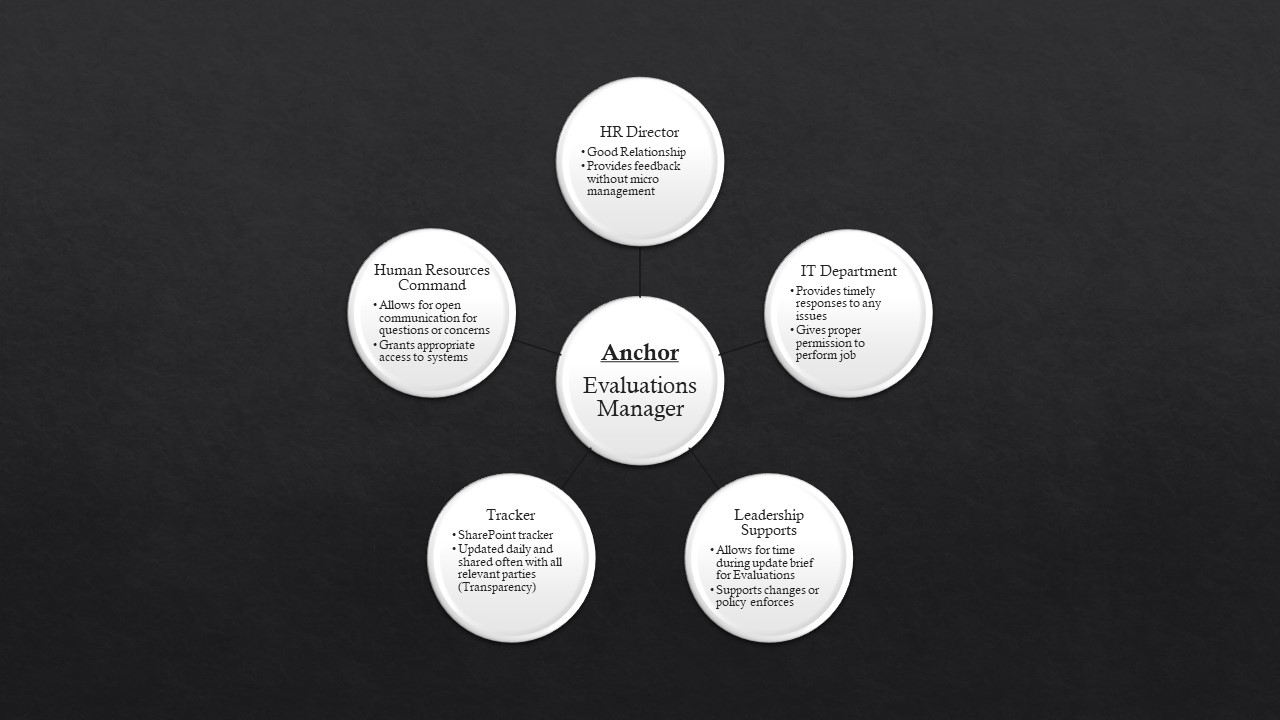
Best practices do not work in real life because they are rarely anchored, specify the web and ignore corner relationships required to make the ‘best practice’ possible. Touting that your department has a ‘best practice’, and then sharing that best practice isn’t as simple as writing up a white paper, and then emailing it to your bros. Best practices should tell a story if ever expected to be understood, let alone implemented.
Essentially, a poorly shared best practice in the financial section, won’t help the maintenance team or logistics section of your organization. BUT… and there is a big but. If properly described and a tale properly told, a best practice can be applicable to any section, department or organization. Elaboration and redundancy are key. You need to specify three layers vertically and then all players horizontally – These layers are, the anchor, the webs and the corners.
Anchor
The anchor is the person writing the best practice or the person the anchor revolves around. This is not to say that your team isn’t tight knit or doesn’t work together, but you must acknowledge who the person is that makes this best practice work – Honesty is very important here. The anchor is not the person who sells the best practice, because it will make him/her look good. You know who I’m talking about. The person with just enough authority in the section to steal the glory is usually the one who puts their name on things in a vein attempt to kiss someone’s ass – or some random manager who thinks because they proof read it, and since they must brief it anyways, they should identify themselves as the anchor. Don’t do it, you’re not helping anybody. The Anchor is the person who developed something that is making an organization do better. Whoever that person is should be identified in the best practice. I don’t care if that person has only worked there for six months or sixty years. After you identify the anchor, you can identify the relationships that make this practice possible. Allowing for this identification can tell any other organization at where the point of influence starts and help identify how many echelons should be involved to make this practice something that can be utilized in their organization. An example of an anchor could be the HR person who manages annual evaluations, or a logistics area manager for Southern California.
Webs
The webs are the relationships the anchor has created or fostered to make this practice work. No one works alone, and best practices are rarely developed and successful within their own information silo. They are, more often than not, built across departments and rely on clear communication and coordination. An example of one web would be a maintenance director who has amazing Just in time (JIT) delivery rates for parts which in turn allows for quick services which in turn allows for vehicles being down for very short periods of time. Should we applaud the maintenance team for keeping low service times, or the logisticians for ensuring timely delivery of parts or should we just high-five the maintenance director for being awesome at his job? Another web could be that HR Evaluations manager we spoke about earlier, may have zero late submissions, an awesome tracker and an appropriate amount of her leaderships time during update briefs. Should we applaud her review skills, the tracker or the leader? Understanding the web is crucial.
Corners
The corners are the part of the web that connect the anchor to an aspect of what helps the process be successful. Let’s go back to the maintenance manager – the part of the story that we left out, is that the logistics manager happens to have graduated from the same school as the maintenance manager, and this has allowed them to be close friends. This isn’t to demean the performance, it’s just to capture that it as a factor. Understanding that this relationship (web) is more than just proper orders or proper fills of those orders could be crucial to a new organization picking up this practice. The part of the story that we left out for the HR manager is that the leadership is adamant about proper recognition and timely reports for his subordinate leaders and not only wants them to be timely but wants them done in a manner that he/she can review them before they are filed away or submitted to another department. In the case of the HR manger, the success is the organizations leader, and in the case of the maintenance manager it is the logistics department who gets the parts in on time.
Pitfalls
People stop before getting whole story – They identify one anchor, one web and one corner and they are done with the ‘best practice’. They shoot off that email, finish up with the slide and head home. This is the problem. We need redundancy – You need to identify every anchor, every web, and every corner. Who else does the maintenance manager work with? What if his maintenance team hates him/her and no matter what parts come in, they won’t rush any work regardless of who’s asking. The team just doesn’t care. What if the HR Evaluations manager has all the support in the world from her leadership, but cannot keep her tracker updated because her computer is old and often breaks down? She can’t keep her tracker updated, she can’t keep properly accountability of her awards and this could damage the entire process. Take the time to identify all the relationships, all of the nuances and you will have properly written a best practice.
 Leaders Check